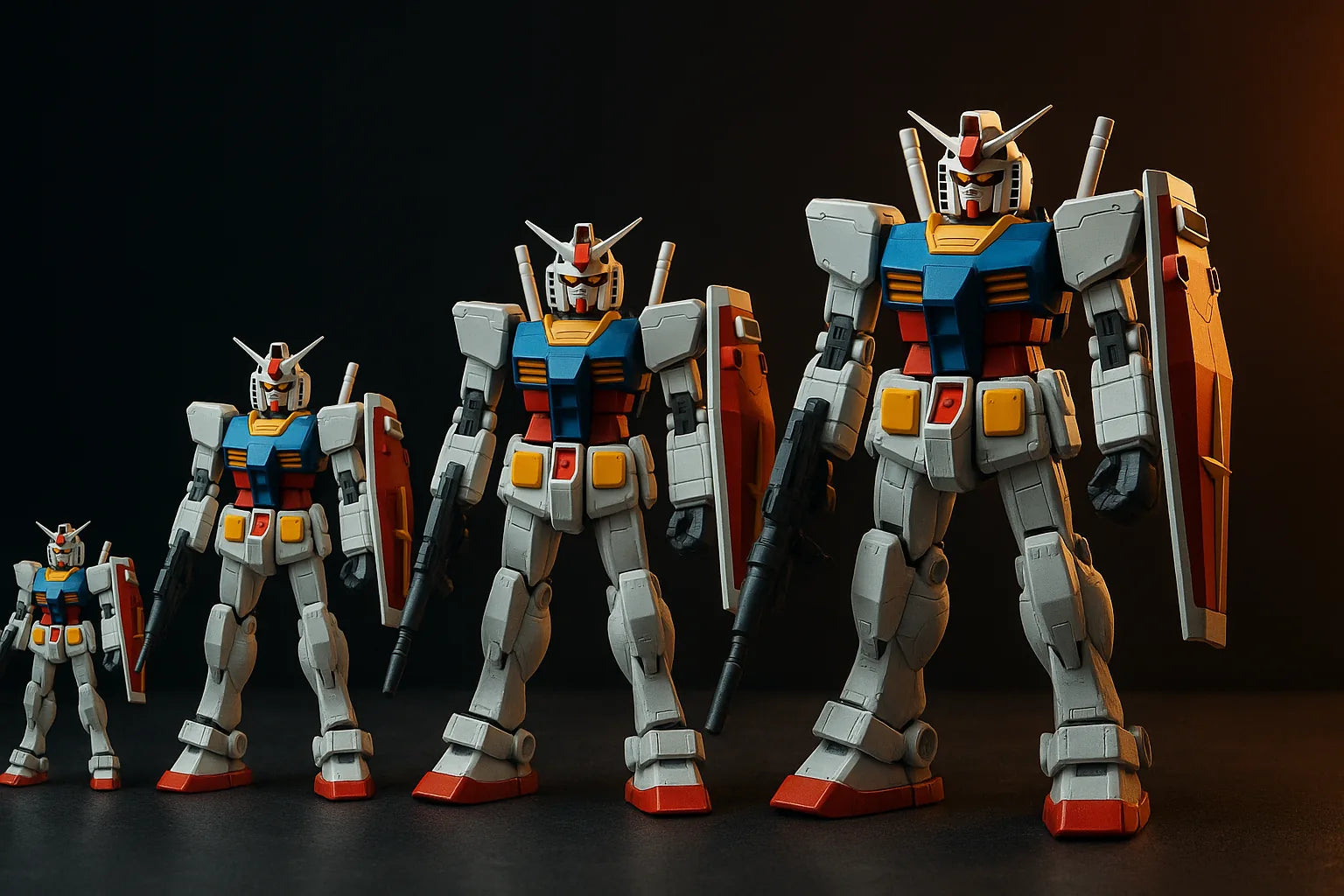
If you have ever browsed a Gundam model kit and wondered why the same mobile suit shows up as an HG, an RG, an MG, and a PG, you are not alone. Those two letter codes are Bandai's grade system, and they tell you almost everything you need to know about a kit before you open the box. This guide breaks down every major Gunpla grade so you can pick the right one for your skill level, your budget, and your shelf.
By the end, you will understand what each grade means for scale, part count, articulation, detail, build difficulty, and price. We will also point you toward the exact kits worth starting with. Whether you are buying your very first snap fit kit or hunting for a centerpiece display model, this is the only grades breakdown you need.
What Does "Grade" Actually Mean in Gunpla?
A grade is Bandai's classification for a Gundam model kit. It is not a quality ranking in the sense that one grade is "bad" and another is "good." Instead, each grade targets a different balance of size, detail, engineering, and price. A High Grade and a Perfect Grade of the same suit can both look stunning on a shelf, but they are built for very different buyers.
Two numbers define most grades: the scale and the part count. Scale describes how large the kit is relative to the real (fictional) mobile suit. Most Gundams stand around 18 meters tall in their fictional universe, so a 1/144 scale kit is roughly 12.5 centimeters, and a 1/100 scale kit is roughly 18 centimeters. Part count tells you how complex the build will be. More parts usually means more detail, more separate colors molded into the plastic, and a longer, more rewarding build.
Almost every modern Gunpla kit is snap fit. That means the parts click together without glue, and colors are molded into the plastic, so you can build a great looking model with nothing but a pair of side cutters. Higher grades reward extra tools and techniques, but none of them strictly require glue or paint.
The Gundam Grades at a Glance
Here is a quick comparison of the five grades most collectors care about. Read the full breakdown below each row for the details that matter.
| Grade | Scale | Typical Height | Part Count | Detail | Difficulty | Price Range | Best For |
|---|---|---|---|---|---|---|---|
| SD (Super Deformed) | Non scale | Around 8 cm | Very low | Stylized, chibi | Very easy | $ | Beginners, kids, quick fun builds |
| HG (High Grade) | 1/144 | Around 12.5 cm | Low to medium | Good | Easy | $ to $$ | First timers and everyday builders |
| RG (Real Grade) | 1/144 | Around 13 cm | High | Excellent for the size | Moderate to hard | $$ | Detail lovers who want big features in a small kit |
| MG (Master Grade) | 1/100 | Around 18 cm | High | Excellent inner frame | Moderate | $$ to $$$ | Enthusiasts who want the best all around experience |
| PG (Perfect Grade) | 1/60 | Around 30 cm | Very high | Top tier, often with LEDs | Hard, long build | $$$$ | Experienced builders and display centerpieces |
SD: Super Deformed
SD kits are the smallest and cutest members of the Gundam family. "Super Deformed" refers to the chibi style: a big head, stubby limbs, and an oversized charm that fits in the palm of your hand. These kits are non scale, meaning they do not follow the 1/144 or 1/100 rules, and they typically stand around 8 centimeters tall.
Scale and Detail
SD kits sacrifice realistic proportions for personality. You will not get accurate silhouettes or deep panel lines, but you do get a surprising amount of molded color and a build that comes together in under an hour. Many modern SD kits, especially the SDCS and SD Cross Silhouette lines, add a small inner frame so you can pose them better than the older versions.
Difficulty and Price
This is the easiest grade to build and the cheapest to buy. SD kits are perfect for a young builder, a rainy afternoon, or a low pressure way to test whether Gunpla is for you. Browse the full SD lineup if you want a fun, low commitment entry point.
Who It Is For
- Absolute beginners and younger builders
- Anyone who wants a fast, satisfying build
- Collectors who love displaying a squad of chibi suits
HG: High Grade
High Grade is the backbone of the entire hobby. If you buy one Gundam model kit this year, it will probably be an HG. These are 1/144 scale kits standing around 12.5 centimeters tall, with a part count low enough to finish in an evening but high enough to look genuinely impressive on a shelf.
Scale and Detail
HG kits deliver clean proportions, solid articulation, and molded color that covers most of the suit. You will occasionally see a sticker or two for finer color separation, but the overall look is excellent for the price. The range is enormous, covering nearly every mobile suit from every series, so you can almost always find the exact design you love in this grade.
Difficulty and Price
High Grade is beginner friendly. A typical build runs one to three hours with nothing but a hobby knife or side cutters. Prices are the most approachable of any "serious" grade, which makes HG the smart choice for building a large collection without emptying your wallet. Explore the full High Grade selection to see just how deep the catalog goes.
Who It Is For
- First time builders learning the basics
- Collectors who want variety and quantity
- Anyone who wants a great looking kit on a budget
RG: Real Grade
Real Grade is Bandai's engineering showcase in miniature. RG kits share the same 1/144 scale as High Grade, so they are roughly the same size at around 13 centimeters, but they pack in a level of detail that used to require a much larger kit. Think of RG as a Master Grade experience shrunk into your palm.
Scale and Detail
The signature RG feature is the pre assembled inner frame, often called the Advanced MS Joint. This one piece skeleton gives the kit incredible articulation and lets the armor snap on over a fully realized frame. RG kits also use extensive color separation and intricate detailing, so a finished Real Grade looks like a museum piece for its size. The tradeoff is that some parts are tiny and fiddly, and that delicate frame can be fragile if you pose it aggressively.
Difficulty and Price
RG is a step up in difficulty. The small parts demand patience and a steady hand, and cleaning up nub marks on such fine pieces takes care. Prices sit above HG but below MG, which makes RG a fantastic value for how much detail you get. If you want maximum wow factor without stepping up to a bigger scale, the Real Grade range is the sweet spot.
Who It Is For
- Builders who have finished a few HG kits and want a challenge
- Detail obsessed collectors with limited shelf space
- Anyone who loves complex engineering in a compact package
MG: Master Grade
Master Grade is widely considered the best all around grade in Gunpla. These 1/100 scale kits stand around 18 centimeters tall, giving you a commanding presence on the shelf and enough real estate for serious detail. For many veteran builders, MG is the perfect balance between size, engineering, buildability, and price.
Scale and Detail
Every Master Grade includes a full inner frame that you build from the ground up before adding the armor. That frame delivers excellent articulation and a genuinely satisfying construction experience, because you are assembling the machine layer by layer. Color separation is superb, hatches often open to reveal internal mechanics, and many kits include extra weapons and accessories. The larger scale also makes MG the ideal canvas for painting, panel lining, and custom weathering if you want to take your skills further.
Difficulty and Price
MG builds are longer, often four to eight hours or more, but they are not necessarily harder than RG. The parts are larger and easier to handle than a Real Grade's tiny pieces, so the difficulty comes from the sheer volume rather than fiddliness. Prices land in the mid to upper range, reflecting the size and part count. For the best balance of build enjoyment and display impact, start with the Master Grade collection.
Who It Is For
- Enthusiasts who want the most rewarding build experience
- Builders ready to try painting and advanced finishing
- Collectors who want statement pieces without going to Perfect Grade prices
PG: Perfect Grade
Perfect Grade is the pinnacle. These 1/60 scale monsters stand around 30 centimeters tall, carry hundreds upon hundreds of parts, and frequently include LED units so the eyes and thrusters light up. A finished PG is the centerpiece of any collection, the kind of model that stops visitors in their tracks.
Scale and Detail
Perfect Grade kits feature the most advanced inner frames in the hobby, with fully articulated hands, opening cockpits, sliding armor, and mechanical detail down to individual pistons. The engineering is astonishing, and the level of realism is unmatched. This is Bandai showing off everything it knows about model design.
Difficulty and Price
PG is a commitment. Builds can stretch across many sessions and total dozens of hours, and the complexity demands experience, patience, and a proper workspace. Prices are the highest of any grade, so this is not a casual purchase. But for the right builder, the payoff is a display model with no equal. When you are ready for the ultimate project, the Perfect Grade range is where legends are built.
Who It Is For
- Experienced builders seeking a marathon project
- Collectors who want a true centerpiece
- Anyone chasing the most detailed Gundam experience available
Which Gundam Grade Should You Choose?
The right grade depends on where you are in the hobby and what you want out of the build. Here is the quick decision guide most builders follow:
- Brand new to Gunpla? Start with an HG. It is affordable, forgiving, and teaches you every core skill you will carry into more advanced grades.
- Want maximum detail in a small kit? Move up to RG once you are comfortable cleaning nub marks and handling small parts.
- Want the best overall build? Go straight to MG for the inner frame experience, larger scale, and painting potential.
- Ready for a showpiece? Take on a PG when you have the time, budget, and confidence for a long, complex build.
- Just want something fun and fast? Grab an SD for a charming, low pressure afternoon.
Many builders climb the ladder over time, starting with High Grade, sampling Real Grade for the detail, settling into Master Grade for the balance, and eventually tackling a Perfect Grade as a bucket list build. There is no wrong path. The best grade is the one that matches the model you love and the time you want to spend.
A Few Tips Before You Buy
No matter which grade you choose, a few basics will make your first build smoother:
- Get a proper pair of side cutters. Thin blade nippers give you clean cuts and fewer visible nub marks than scissors or a knife.
- Read the manual page by page. Gunpla instructions are almost entirely visual and easy to follow once you know the flow.
- Take your time on nub cleanup. A little sanding or a second, closer trim keeps parts looking clean straight out of the box.
- Match the grade to your patience. If you want a finished model tonight, pick HG or SD. If you want a project, reach for MG or PG.
Ready to start building? Check out our roundup of the best Gundam model kits for hand picked recommendations across every grade, then dive into the collection that fits your style. Whichever grade you choose, you are about to discover why Gunpla is one of the most rewarding hobbies out there.